


TERF Wars and Trans-terrorism
10 years ago

Ritual is not only about entertainment. It is not only a pleasant pastime or an opportunity to socialize. It is not even simply a psychological tool to shape ourselves and our communities through shared emotional or aesthetic experiences, though it can certainly be used this way.
At the heart of my spiritual life rests the deep knowing that ritual is a way of listening to the Song of the World as it moves through the earth and the land, and engaging with that Song as something holy, wholly challenging and transformative. Shared ritual is when we accept the burden and blessing of being embodied beings of this dense, physical world that gives us life, and when allow ourselves to respond in kind, to speak back to the natural world with its energies and currents and wild mysteries. Ritual is not for our sake alone, but for the sake of the whole world. It is for the sake of the solitude and silence that surrounds us, that frightening shadow of void and absence that makes us who we are, makes us whole.
We ignore it or seek to replace it at our own peril, for the world is what is real. Even in our deepest solitude, the world of experience and natural forces persists.
* * *
We have been neglectful and arrogant for a long time in this country, intoxicated with our own power, lulled into disconnection by our own thirst for convenience and speed and ease. Those years of solitude I spent grieving and kneeling to the dust on the floor were not made up of my grief alone. The land, too, grieves. She misses us. She longs for us to once again touch her as a lover caresses the beloved, to whisper to her of our secret dreams and sit with her in the long silences of twilight. She aches to be with us in our ritual and our prayer. She loves to feel the pounding of our feet and our drums in dance and song and praise — not the scraping and gnawing of our machines and our indifference and our consumerism and our denial.
Our religious communities are not only human. The world, too, the earth and her creatures and her ecosystems and forests and rivers and storms — all these are part of our community of spirit, the community from which our lives crest and subside again like waves of the ocean. And we cannot embrace the world in its wholeness and holiness if we seek to escape it or deny it through digital media that robs it of its voice and deadens our ability to listen to its thrumming presence in even the deepest silences and loneliest moments. Digital and social media have their place, they can give us some direction and help us to share ideas and information across the globe. But they cannot ever replace the hard, necessary work of showing up to ourselves in all of our limited, bounded, frustratingly beautiful imperfections and engaging in the wildness and wilderness of a world so much bigger than we are.
For decades, our culture has struggled with two addictions: to oil and to despair. But what if our lives were as immersed in nature as in technology every day? What if we not only conserved nature, but created it where we live, work, learn and play? The filmmaker Camilla Rockwell recently sent me a clip from her film Mother Nature’s Child: Growing Outdoors in the Media Age.
Richard Louv: Human Energy Through Nature Connection from Camilla Rockwell on Vimeo.
Find a guide book. Consider “I Love Dirt,”; Joseph Cornell’s classic “Sharing Nature With Children”; and “Coyote’s Guide to Connecting with Nature.”I'm going to buy Coyote's Guide to Connecting with Nature for me and G/Son.

I don't know what it has been like where you live, but here it seemed winter would last forever. It was just last week that I was bundled up and huddled along the ice-bound shores of the lake waiting for the sun to rise. I still had the chance to make ice sculptures it was so cold here. The snow was deep in the woods, but it was crystallized and granular. The delicate flakes long gone, but now a coarse sugary texture. Difficult to make sculptures with as it does not stick together well. So this time of year is tricky in terms of making sculptures. But the sun is so strong now that the snows do melt, even if the temperatures can only rise to the low 40s which was all that could be managed last week. But the emerald green mosses are emerging and letting me know that soon, very soon it will be time to play with this exquisite green once more.
The combination of melting snow and icy nights makes for some fascinating sculptures to be found however! One day, while walking in a nearby field, I found these delicate polka dot creations creating an exquisite lace effect at the edge of the snow. The day was grey and the wind was cold, but the day before had been sunny. Just warm enough to create the droplets on the underside of the paper thin ice... which re-froze in the chill and still night air.

For those of us who care for an earth not encompassed by machines, a world of textures, tastes, and sounds other than those that we have engineered, there can be no question of simply abandoning literacy, of turning away from all writing. Our task, rather, is that of taking up the written word, with all of its potency, and patiently, carefully, writing language back into the land. Our craft is that of releasing the budded, earthly intelligence of our words, freeing them to respond to the speech of the things themselves – to the green uttering forth of leaves from the spring branches. It is the practice of spinning stories that have the rhythm and lilt of the local soundscape, tales for the tongue, tales that want to be told, again and again sliding off the digital screen and slipping off the lettered page to inhabit these coastal forests, those desert canyons, those whispering grasslands and valleys and swamps. Finding phrases that lace us in contact with the trembling neck-muscles of a deer holding its antlers high as it swims toward the mainland, or with the ant dragging a scavenged rice-grain through the grasses. Planting words, like seeds, under rocks and fallen logs – letting language take root, once again, in the earthen silence of shadow and bone and leaf.
~David Abram

We know what the animals do, what are the needs of the beaver, the bear, the salmon, and other creatures, because long ago men married them and acquired this knowledge from their animal wives. Today the priests say we lie, but we know better. The white man has been only a short time in this country and knows very little about the animals; we have lived here thousands of years and were taught long ago by the animals themselves. The white man writes everything down in a book so that it will not be forgotten; but our ancestors married animals, learned all their ways, and passed on this knowledge from one generation to another.
- A Carrier Indian, from the Bulkley River, in British Columbia
Flight From Embodiment from Alliance for Wild Ethics on Vimeo.

[H]ealing the broken bond between our young and nature—is in our self-interest, not only because aesthetics or justice demands it, but also because our mental, physical, and spiritual health depends upon it. The health of the [E]arth is at stake as well. How the young respond to nature, and how they raise their own children, will shape the configurations and conditions of our cities, homes—our daily lives.
To heal the [E]arth . . . you must connect with the elements, the plants, the animals, and all forces of nature. You must reestablish your connection with the web of life, seeing that you are not separate from the rest of life, and you must see the beauty in all things.
. . .
Intention You must set a strong intention to return to living in accordance with the laws of nature, remembering [that] you are part of the web of life and are ruled by, and a part of, the cycles of nature. You must set an intention to open the lines of communiation with the spirit that lives in all things.
Love As you open to the wisdom of the trees, the plants, the animals, the insects, the sun, the moon, the stars, and the elements, you learn that all life thrives on love, and love is a key to creating harmony.
Harmony If you return harmony to yourself by aligning yourself with the river of life, the river of life will bring harmony back to you and the planet.
Union When you remember your connection to the web of life, and the spirit that lives in all things, you are once again in union with yourself, the rest of life, and the divine.
Focus You must focus on your intention to open the lines of communication with the spirits of nature.
Concentration You must concentrate on intentionally changing your way of life to once again return to harmony with yourself and the natural world.
Imagination You must be able to imagine the spirits and forces of nature that live around you, the forces of nature that live in you, and a world in harmony and balance again. You must be able to use your imagination to see the beauty in all things.
I think this concept of relationship with the land is the idea some people are oversimplifying when they talk about grounding with a local tree or observing the seasons.
. . .
I just about jumped up and down when I saw the photo [used to illustrate the post] - I recognize that area, because my personal connection is with Teddy Roosevelt Island. Building my relationship with the land there is based on observing the seasons, but not just as an abstraction: it's about noticing what's going on, what the changes reflect, what the spirit of the place feels like and how that changes. It's a deep kind of knowing, and I think the idea of relationship captures it better than anything else I've seen. Being in love takes effort - but it has the most rewarding results.
You must focus on your intention to open the lines of communication with the spirits of nature. . . . You must concentrate on intentionally changing your way of life to once again return to harmony with yourself and the natural world.

In the world of child development, attachment theory posits that the creation of a deep bond between child and parent is a complex psychological, biological, and spiritual process, and that that without this attachment a child is lost, vulnerable to all manner of later pathologies. I believe that a similar process can bind adults to a place and give them a sense of belonging and meaning. Without a deep attachment to a place, an adult can also feel lost.
. . .
Attachment to Land is not only good for the child, but good for the land as well. As naturalist Robert Finch asserts: "There is a point . . . in our relationship with a place, when, in spite of ourselves, we realize we do not care so much anymore, when we begin to be convinced, against our very wills, that our neighborhood, our town, or the land as a whole is already lost." At this point, he argues, the local landscape is no longer perceived as "a living, breathing, beautiful counterpart to human existence, but something that has suffered irreversible brain death. . . . "[I]t no longer moves, or if it does, it is not with a will of its own."
...
Passion does not arrive on videotape or on a CD; passion is personal. Passion is lifted from the [E]arth itself by the muddy hands of the young; it travels along grass-stained sleeves to the heart. If we are going to save environmentalism and the environment, we must also save an endangered indicator species: the child in nature.
Aurora Borealis timelapse HD - Tromsø 2010 from Tor Even Mathisen on Vimeo.

You are beautiful, but you are empty. One could not die for you. To be sure, an ordinary passerby would think that my rose looked just like you — the rose that belongs to me. But in herself alone she is more important than all the hundreds of you other roses: because it is she that I have watered; because it is she that I have put under the glass globe; because it is she that I have sheltered behind the screen; because it is for her that I have killed the caterpillars (except the two or three that we saved to become butterflies); because it is she that I have listened to, when she grumbled, or boasted, or ever sometimes when she said nothing. Because she is my rose.
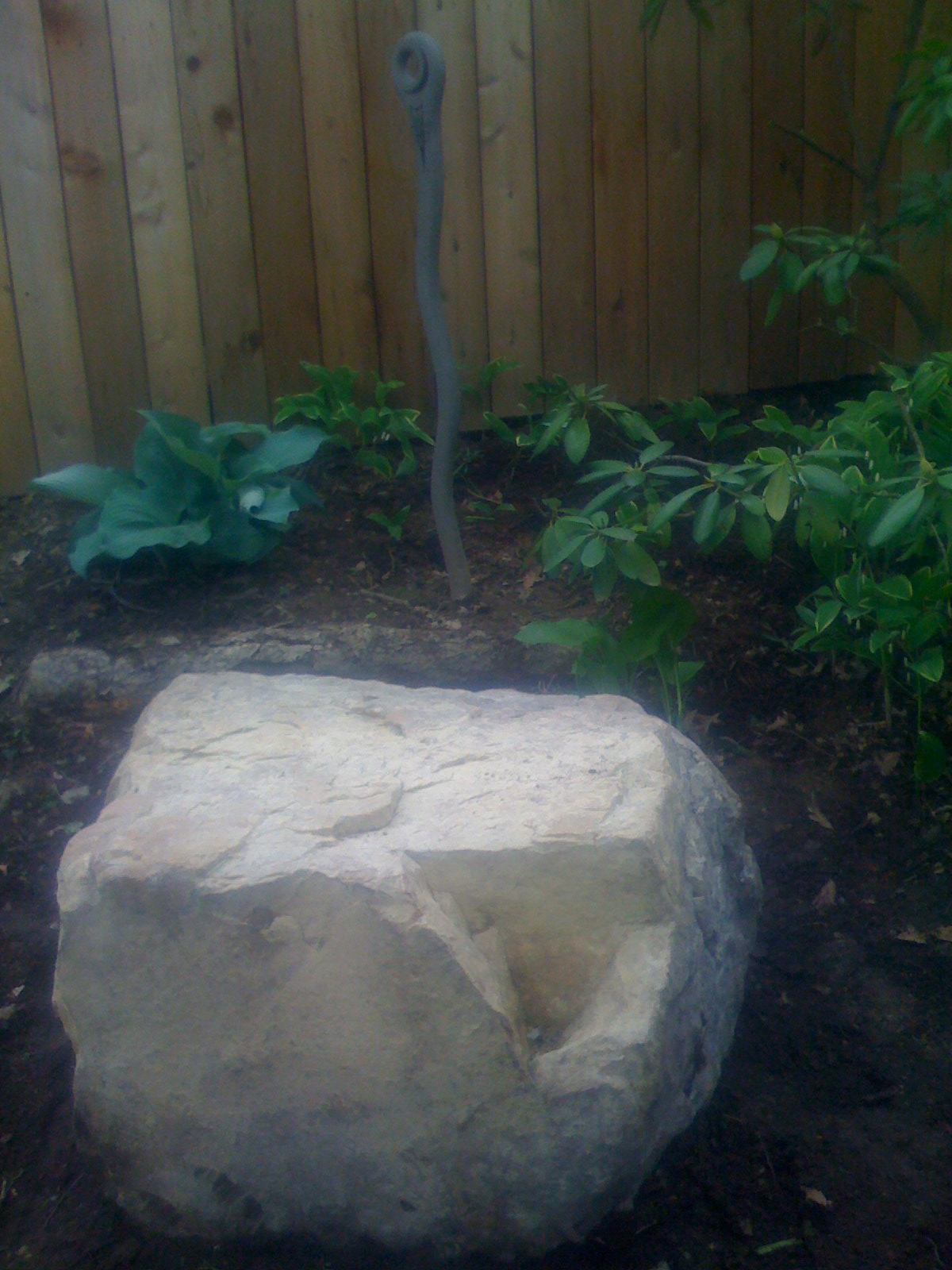
This is my rock
And here I run
To steal the secret of the sun.
This is my rock
And here come I
Before the night has swept the sky.
This is my rock
This is the place
I meet the evening face to face.
"I believe that one of the greatest causes of the ecological crisis is the state of personal alienation from nature in which many people live. We lack a widespread sense of intimacy with the living world. Natural history has never been more popular in some ways, yet few people organize their lives around nature, or even allow it to affect them profoundly. Our depth of contact is too often wanting.~Robert Michael Pyle

It takes time -- loose, unstructured dreamtime -- to experience nature in a meaningful way. Unless parents are vigilant, such time becomes a scarce resource, because time is consumed by multiple invisible forces; because our culture currently places so little value on natural play.

This grand show is eternal.
It is always sunrise
somewhere;
the dew is never all dried at once;
a shower is forever falling;
vapor is ever rising.
Eternal sunrise,
eternal sunset, eternal dawn
and gloaming, on sea
and continents and islands,
each in its turn,
as the round earth rolls.
And for all this, nature is never spent;
There lives the dearest freshness deep down things;
And though the last lights off the black West went
Oh, morning, at the brown brink eastward, springs --
Because the Holy Ghost over the bent
World broods with warm breast and with ah! bright wings

The call to look out for and tend to a place, a piece of land that has magic about it, made me think immediately of the Paschberg and the trails (don't worry Mom, I'm not converting to Wicca!). The Paschberg wears some of its history on its sleeve (Tummelplatz, Battle of Bergisl just steps away, the FLAK rings on Landser Kopf) and some of it you have to look for (rocks with cup markings.) Yesterday I walked the trails, instead of my usual jog, and looked for signs. I found a few, but also a lot of tiny litter scraps, and so I began to pick them up.
In our best of times everything turns into religion, all the world seems a church and the mountains altars.


