CURRENT MOON

Wednesday, June 07, 2006

They Didn't Sign Up for All of This


I decided a while back that it would be a good idea if people could actually see what Hillary Clinton's been saying, rather than repeating misconceptions about her. Here's a speech that she gave on June 5th to a group of supporters.


There are issues, and there are lots of challenges we have faced as a nation. I know there are strong opinions on issues we've been dealing with and I respect that greatly. I think what is important now is that we stand together and try to change the direction of our country. I don't think anyone can look at our country and not be proud.

Five and a half years ago, we had a lot of challenges that we needed to confront as a nation. And I just getting my feeling in the Senate when September 11th happened - it really changed everything - it changed everything, the extraordinary damage that was done to our city and individual lives. But I think all of us, whether we we're directly impacted or not, knew that NY had an unprecedented set of challenges that we had to respond to. And I'm very proud of the resilience and the patriotism and the courage and the conviction that so many New Yorkers brought to the day, weeks, months and years following 9/11.

Some of you in the crowd, I know have been great champions of the work that we tried to do to take care of the victims of 9/11 and their families to make sure that they we're given the support that they needed. Many people worked with me to try to contend with the health effects that so many of our first responders are confronting because of the toxic mix of the air after the collapse of the buildings.

But every New Yorker I know has really stood up and spoken up on behalf of not only the survivors, victims of 9/11, not only our heroes, our firefighters, police officers, emergency workers, and all who rushed to down to Ground Zero to conduct the most successful rescue mission in the history of our nation or maybe even the world. But there was the sense that we're all in this together, that we had to support each other. And that's how I tried to make decisions over the last now nearly five years. It has been a very difficult set of issues about how do we protect ourselves, how we remain vigilant, how we deal with those who wish us harm - because make no mistake about it, they are out there, they are here they are no respecter of geographic boundary or sex or race or gender or anything else.

And so, trying to balance off what we have to do to continue to make America a country we can be proud of, to focus on challenges confronting us and to really keep in mind the next generation, to me is a hallmark of what you are supposed to do in public life, while recognizing that as New Yorkers we have to take on the additional responsibility of doing everything we could to protect our city and our state and our country.

There was a great opportunity after 9/11 for the entire country to come together. I had some basic disagreements with the current administration, but more heartbreaking to me was the decision made by the highest levels of the administration to segment our country, to go after specific hot button issues - really divide us - when after 9/11, I think the President could have asked us to do anything and we would have done it.

If he had said, "I wish you would use less gas so that we would be less dependent upon foreign oil," we would have done it.

If he had asked to us to be more cognizant about how we treat each other and to really look for ways that we could work to meet the needs of all children - particularly poor children so that they had the chance to fulfill their God-given potential - we would have done it.

If he had said, "You know, we need to really tackle the health care problem now because we're losing jobs, we can't keep doing what we're doing - it's just not working," we would have done it.

There were so many opportunities, and unfortunately a different kind of decision was made. We're seeing again this week, when I leave here to fly back to Washington, we're going to be debating this week an amendment to the United States Constitution that bars gay marriage.

Now, when I travel around and speak with people who I represent, and hear about everything from terrorism to gas prices to childhood health care to energy independence to global climate change to affordable housing - there's a long list - but this is not on the list.

It is unfortunately on the list for the political machine of the White House and the Republican majority, and so I hope that as we weigh the campaign for reelection and I try to help elect Democrats around the country to take back one or two houses of Congress, we will all stand up and be counted.

We will all stand up for a return to fiscal responsibility that will give us a chance to make the right decisions and investments that will make our country richer and stronger in the future. We will stand against the wrongheaded decisions that are being made by the administration and Congress that are slashing so many of the programs to the most vulnerable among us and not giving people the confidence to make smart investments in energy independence and protecting ourselves against global climate change - and so many of those problems that none of us can deal with individually - we have to work together, and we have to work through our government.

We need to stand up to stand up on behalf of energy independence; it is the most important challenge when you look at where we are economically, from a serious perspective, from the environment. Just in the last few days, we had threats form Iran that they we're going to somehow choke off our oil supply. Well, I hope that doesn't happen. Wouldn't it be a great to be in a position where we could basically say, "Go Jump in the Lake"? -- Where we wouldn't have to be dependent on the theocrats and the autocrats and the dictators that control so much of the oil supply of our nation.

And I hope everybody sees Vice President Gore's movie, because it shows us how to make smart decisions about how we can finally deal with this issue.

And health care, which I mentioned, does not go away as an issue; in fact it is even more because the costs keep going on the number of uninsured people keep going on, the jobs we move keep going up, and yet we are not tackling this problem in a way that we should.

And there are things that we should do right now. I've worked in a bipartisan way every chance I could - obviously there are issues like social security or a women's right to choose where you can't work in a bipartisan way; you have to stand your ground - but when it comes to changing certain things in health care, you can work together. I've worked with Senator Bill Frist to pass legislation that will give us a health information technology program for computerized medical records that will save us billions of dollars, and improve Medicare, and improve quality health care, and that's the kind of approach we need so we can get a good base of information to be able to make the hard decisions about how we're going to deal with our health care situation.

When it comes to education - there are a lot of educators in this room - we still have not figured out how we're going to provide resources so that school districts can help children learn without having to raise property taxes to an unaffordable level. And what we have to do is fully fund No Child Left Behind Program and fully fund special education, so that those funds are available and school districts can use them to equally fund children's education as they need.

We also know that when you look at the various issues that we're confronting as a nation, that it's not enough for us to just hope that we're going to have better relations around the world. We need to get back in the business of building alliances, not alienation, because we need friends and allies. We need people who we will pick up the phone and call one of our government officials, or their government, to support suspicious activity. We need people to go out rooting for freedom and democracy and decency, not rooting against us. And we can't do that unless we have an attitude in our country that reaches out and includes people, not pushes them away. And we're gong to have to be changing how we relate to the rest of the world if we expect it to be successful in the future.

We also know that as we look around the world that there are so many people who are suffering from diseases like HIV, AIDs, malaria, tuberculosis, who are suffering from environmental degradation and the lack of clean drinking water, who are easy prey for those who take the damage of them. The United States has been a beacon of hope and opportunity. The number one country in the Islamic world that has the highest opinion of the United States today is Indonesia. Why? Because after the tsunami, we were there to help, and that's how we need to be seen to win the hearts and minds of people around the world.

We need to be willing to stand up and fight up for those values. And here at home, we need to continue to protect and nurture that which had made America great and has made it the envy of the world.

Now there is a way to track down terrorists that is within the rule of law and not outside of it. We know that our civil liberties and our right to privacy and our individual freedoms are not a luxury - they are what set us apart from the rest of the world. Our respect for the rule of law is what makes America unique and gives us the confidence to defend against our government, to be politely active and fight for causes that we think are important. We cannot allow our constitutional democracy to be eroded. We can have global security and liberty.

Our founders did that and we can be smart enough to do it as well. I also believe that we protect a woman's right to choose. We have to ensure that abortion is legal, safe, and rare. My good friend Nita Lowey and I, introduced a resolution in Congress - she in the House, I in the Senate - asking Congress to go on record in support of family planning. We want to get people to register their votes, because this is not just about abortion, this is also about contraception. There is a concerted effort to turn the clock back on the women's law. And we all need - Republicans, Democrats, and Independents - we all need to stand together and make it very clear that we will not go back. As I travel around our state, I'm encouraged by the number of the people who come to my events who say they didn't support me last time and tell me that they are Republican, and I always say, "We're glad you're here. Welcome." And I also ask them, "Well, why are you here?" And they always say something like, "I didn't sign up for all of this."

They didn't sign up for a government that interferes with personal, private, intimate relations.

They didn't sign up for a government that's sending us into debt.

They didn't sign up to be the largest debtors in the history of the world where we have to borrow $60 billion a month from China, Japan, and others.

They didn't sign up for Terry Schiavo to be turned into a tragic, political problem.

They didn't sign up for the United States government who totally dismantled the Federal Emergency Management Agency and battled with colleagues and didn't know what to do.

They didn't sign up for the mean-spirited divisiveness against gays and lesbians and tried to make it somehow a political issue as to the life you lead and who you are.

They didn't sign up for the politicization of fining; they didn't sign up for the Environmental Protection Agency - which has turned into a misnomer - to tell people mercury in the air and arsenic in water won't hurt you.

They didn't sign up for an FDA that refuses to make a decision about the emergency contraception known as Plan B.

They didn't sign up for a president who denies global climate changes and refuses to deal with reality of what is happening in our world that has far-reaching consequences for our children and our children's children.

There's a long list why people are suddenly saying, "We didn't sign up for this." You know, this is not a conservative administration; there is nothing conservative about it. It is radical; it is undermining our constitutional democracy. It's turning back years and years of our constitution.

I think we've got the potential for a very positive election in this November if we all work together. We have races right here in New York where Democrats are running for Congress in traditionally Republican districts and finding a lot of support.

We have races all over the country where people run for the Senate, run for the House, are finding that they have a receptive audience, because if we don't take back one or both houses of Congress, we cannot change the direction of the country; we cannot convince the administration of the Republican majority to make decisions based on evidence, not ideology. We can't deal with what we need to do in Iraq if we don't have a Congress that can conduct investigations and make it absolutely clear that the administration, that their failure in Iraq has endangered not only our men and women in uniform, not only the Iraqi people, but the entire region.

I'm very optimistic not only about the election but about our country. You know, I really believe that we do fit into what Winston Churchill once described where he says, "You know the American people, they always do the right thing after trying nearly everything else," and I believe that. I know that. We're dealing in a real tactical manner with the challenges that we face, when we elect new people who will be open and willing to work together to seek common ground, but to have more citizens involved as well, because we are a enjoying them in our country.

You know I can see very clearly, we can go on one path where we ignore our problems, where a very small percentage of people - like my husband and me, we do very well - but where the rest of the country kind of marches in place or is glued to the ground because we're not creating the rapid opportunity; we're making it more expensive for kids to go to college than we did 25 years ago, we're shutting the door on working young people who want a better a life or come down on pre-school programs when we know if we don't give kids a good head start, they'll never catch up. We're turning our backs on how give people decent opportunities for housing and transportation.

We know what the pillars of the middle class look like; we've been taking advantage of them for more than 50 years in our nation, and we are the beneficiaries of that.

So I don't want to go down the path where we undermine the quality of the seniors living in our country, where we have a college needed in the community, where the nation venture forth from our world recreational travel because we're not wanted. That does not have to be the picture. Instead, we can begin working together again - rebuilding the consensus we had in this country until relatively recently about what we needed to do, to build a strong America at home and aboard. And when we do that, we will know how the resilience and energy came from right here in New York. The example that was set by New Yorkers on 9/11 and in the weeks since is the example set by my friend Lauren Manning, who is here today and so many others who have suffered.

That's what makes America great, and we will once again reclaim our greatness. Thank you all very much!

Tuesday, June 06, 2006

We Are Coming to a Period of Consequences


Went yesterday to see AIT, Al Gore's movie on climate change. I've been trying since then to organize my reactions into something coherent, but, really, how do you do that? How do you watch a documentary about the end of your own civilization, not to mention thousands of other species, and then organize your thoughts? So, here are some reactions, although not necessarily integrated into anything resembling an essay or an article.

First: Go. Don't wait for the DVD. Go tonight. Go today. Go this week. Go. Pay people if that's what you have to do to get them to go along with you. Go. I fancy myself a rather well informed eco-feminist, but I've never seen this information presented this clearly, this starkly, this compellingly.

Second: I wish this had been Gore's campaign. This slide show. This is his passion and that comes through in every single frame. And Americans who won't go see the movie really need to see this.

Third: For a very long time in my early adult years, I would read things written by mystics and just throw up my hands. I wanted rather desperately to understand what they experienced and how they managed to get to that point, but nothing that they wrote made any sense to me. I was recently reading something in a book that Prior Aelred sent to me that reminded me of how I used to feel. This passage would have made NO sense to me at one time:

"The ultimate reality that is known in contemplative experience and in unitive wisdom has been called simply the center. It is the metaphysical center of all reality and also the center of the human person. Corresponding to the presence of this reality at the center of the human person is a unitive Self: atman, true self, Christ-self. This is the human person, fully participating in the unitive divine Source; it is, therefore, being-in-communion, the person as essentially relational. This unitive reality, as the center of the person, is also the ground of human consciousness. Human consciousness and all of its operations are grounded in a unitive participation in the absolute divine Reality." Second Simplicity: The Inner Shape of Christianity by Bruno Barnhart.

I'd have had no clue what Barnhart was going on about. How DO you "participate fully in the unitive divine Source"? What does it mean to say that "Human consciousness and all of its operations are grounded in a unitive participation"?? I'd have given up.

But, like having sex or eating oysters or finally really dancing instead of "doing dance steps" -- once you have had a mystical experience, then all the descriptions of mystical experience and instructions for how to "get there" suddenly make sense. Until then, no one can really tell you in a way that will make any sense.

Which is a long way round to say that one of the first descriptions of a mystical experience that ever hit a chord with me comes from a novel about Stonehenge called Pillar in the Sky. In that book, one of the builders of Stonehenge looks at the structure that is being erected and says, "I am with my father's father's father and with my son's son's son's." So many writers about mystical experience say that the mystical experience is "timeless," that "time ceases to exist," that "time stands still." But I like the Stonehenge description better.

Watching AIT yesterday, I felt as if I were having the mirror reaction. Suddenly, instead of time not existing, I felt that time not only exists, but is, for the purposes of our civilization and possibly our species, coming to an end. I can't be with my son's son's son because, within the lifetime of my son's son, the world may end.

I'll end this part of the discussion by noting that my first mystical experience involved really seeing sunlight on tree leaves. Watching Gore's slides about deforestation just made me incredibly, incredibly sad.

Fourth: What you have to realize as Gore discusses much of the land mass of India disappearing and large sections of the Earth experiencing water deficits is that there will be massive social disruption. We saw how, even on the scale of New Orleans -- which will be as nothing compared to, say, India -- people showed up with guns at bridges to keep all "those others" from coming into "their" territory. Now imagine India with hundreds of thousands of homeless refugees needing somewhere to go.

India has the atom bomb. So does China. We're seeing wars now over oil. We'll soon see wars over land and water. People will look for an "other" to blame for "God's wrath." Women, gays, minorities can expect to be persecuted on an increasing basis. Times of social upheaval often cause people to turn to authoritarian leaders. Civil rights and human rights are going to suffer.

That's the logical consequence of driving Hummers, refusing to join Kyoto, leaving George Bush in the White House, and allowing Enron and the oil companies to meet in secret with Dick Cheney. In the end, Gore's quote from Churchill is spot on: "The era of procrastination, of half-measures, of soothing, and baffling expedience of delays is coming to a close. In its place, we are coming to a period of consequences."

California!


If you live in California, the MOST IMPORTANT THING YOU CAN DO TODAY is to go to the polls and vote for the Democrats. Do it for your grandchildren who need the Greenland ice shelf to stay in place. Do it in honor of Califia, the Amazon Queen for whom your great State was named. Do it to piss off Bill O'Reilley and Rush Limbaugh. Do it to scare Joe Lieberman. Do it to make Dick Cheney snarl and shoot people in the face. Do it because Bush and Cheney told California they didn't care how many black outs it suffered. Do it because it's the right thing to do. I don't care why you do it. But, please, do it.

Monday, June 05, 2006

MotherFucker


Via Wild Hunt comes this fascinating post about the frappin Pope Ratzi the Nazi calling the Nazis "pagans" and "neopagans." And, you know, at first blush, you'd be tempted to say that he ought to know, having been a Hitler Youth himself.

But no, it's just an attempt to smear today's Pagans and NeoPagans.

I dislike this man more and more every day.

Shiny Chapeau


Chas Clifton links to a great study on tin-foil hats.

Among a fringe community of paranoids, aluminum helmets serve as the protective measure of choice against invasive radio signals. We investigate the efficacy of three aluminum helmet designs on a sample group of four individuals. Using a $250,000 network analyser, we find that although on average all helmets attenuate invasive radio frequencies in either directions (either emanating from an outside source, or emanating from the cranium of the subject), certain frequencies are in fact greatly amplified. These amplified frequencies coincide with radio bands reserved for government use according to the Federal Communication Commission (FCC). Statistical evidence suggests the use of helmets may in fact enhance the government's invasive abilities. We speculate that the government may in fact have started the helmet craze for this reason.

Sunday, June 04, 2006

Grandson Blogging


Three months old today!!! His Nonna loves him sooooooooooo much!

American Exceptionalism


"It's disturbing to see how neatly nationalism dovetails into fascism. While we must not allow the fascists to define what the nation is, or who it belongs to, it's worth keeping in mind that nationalism, in all its many avatars—socialist, capitalist and fascist—has been at the root of almost all the genocides of the twentieth century. On the issue of nationalism, it's wise to proceed with caution."


Arundhati Roy, April 2002

Mote in Your Neighbor's Eye, Log in Yours, Etc.


You know, the reaction of the Chinese government to Tiananmen Square sucked ass.

But, I've got a great idea for the catholic church. Before you run around "strongly criticizing the Chinese government and calling on it to hold a full and open review of the killings," HOW ABOUT IF YOU strongly cirticize YOURSELF and "hold a full and open review of the killings" that occurred in the FREAKIN' INQUISITION THAT YOU FREAKIN' STARTED FOR THE SAME FREAKIN REASON THAT BUSH IS GIVING A SPEECH TOMORROW AGAINST GAY MARRIAGE, YOU FREAKIN HYPOCRITES?

Full Moon Performance by My Brilliant Friend Amy to Benefit Cecelia Fire Thunder


IIIIIIIIIIIIIIIIIIIIIIIIIIIIIIIIIIIIIIIIIIIIIIIIIIIIIIIIIIIIIIIIIIIIIIIIIIIIII
BENEFIT 4 REPRODUCTIVE RIGHTS JUSTICE IN SOUTH DAKOTA
IIIIIIIIIIIIIIIIIIIIIIIIIIIIIIIIIIIIIIIIIIIIIIIIIIIIIIIIIIIIIIIIIIIIIIIIIIIIII

Sunday June 11 7:30-10:30pm
CATTYSHACK
249 4th Avenue (between President & Carroll)
(R to Union St or F to 4th Ave/9th St.)
Brooklyn - Park Slope, NYC
www.cattyshackbklyn.com

MC'd by the Missile Dick Chicks

Special Guest: Jennifer Baumgardner
Music by Amy Clarke
Stand-Up by Courtney McLean
Video Clip of the film "Speak Out: I Had An Abortion"
Raffle, and More!, $10
RSVP appreciated: feminist9@yahoo.com

All proceeds go to Cecelia Fire Thunder, President of the Oglala Sioux Tribe, and Planned Parenthood of South Dakota. Fire Thunder announced that she would start an abortion clinic on tribal lands, if the draconian ban that was passed in SD is not repealed by the referendum.

Sunday Akhmatova Blogging


I don't know if you're alive or dead

I don't know if you're alive or dead.
Can I look for you on earth,
Or, only when the sunsets fade,
Mourn you serenely in my thought?
All is for you: the daily prayer,
The sleepless heat at night,
And of my verses, the white
Flock, and of my eyes, the blue fire.

No-one was more cherished, no-one tortured
Me more, not
Even the one who betrayed me to torture,
Not even the one who caressed me and forgot.

1915

Friday, June 02, 2006

It Is Not a Political Issue; It Is a Moral Issue


Via Miniver Cheevy, one of my new favorite blogs, comes this review by Roger Ebert of Al Gore's new movie, AIT: "'In 39 years, I have never written these words in a movie review, but here they are: You owe it to yourself to see this film.'"

Ebert goes on to say, "In England, Sir James Lovelock, the scientist who proposed the Gaia hypothesis (that the planet functions like a living organism), has published a new book saying that in 100 years mankind will be reduced to 'a few breeding couples at the Poles.' Gore thinks 'that's too pessimistic. We can turn this around just as we reversed the hole in the ozone layer. But it takes action right now, and politicians in every nation must have the courage to do what is necessary. It is not a political issue. It is a moral issue.'

When I said I was going to a press screening of "An Inconvenient Truth," a friend said, "Al Gore talking about the environment! Bor...ing!" This is not a boring film. The director, Davis Guggenheim, uses words, images and Gore's concise litany of facts to build a film that is fascinating and relentless. In 39 years, I have never written these words in a movie review, but here they are: You owe it to yourself to see this film. If you do not, and you have grandchildren, you should explain to them why you decided not to."

I have a grandson. I'm seeing the movie on Monday night with a group of witches. I hope that you will see it, too.

Friday June Poetry Blogging


What is So Rare As a Day in June?

AND what is so rare as a day in June?
Then, if ever, come perfect days;
Then Heaven tries earth if it be in tune,
And over it softly her warm ear lays;
Whether we look, or whether we listen,
We hear life murmur, or see it glisten;
Every clod feels a stir of might,
An instinct within it that reaches and towers,
And, groping blindly above it for light,
Climbs to a soul in grass and flowers;
The flush of life may well be seen
Thrilling back over hills and valleys;
The cowslip startles in meadows green,
The buttercup catches the sun in its chalice,
And there's never a leaf nor a blade too mean
To be some happy creature's palace;
The little bird sits at his door in the sun,
Atilt like a blossom among the leaves,
And lets his illumined being o'errun
With the deluge of summer it receives;
His mate feels the eggs beneath her wings,
And the heart in her dumb breast flutters and sings;
He sings to the wide world, and she to her nest,
In the nice ear of Nature which song is the best?


Now is the high-tide of the year,
And whatever of life hath ebbed away
Comes flooding back with a ripply cheer,
Into every bare inlet and creek and bay;
Now the heart is so full that a drop overfills it,
We are happy now because God wills it;
No matter how barren the past may have been,
'Tis enough for us now that the leaves are green;
We sit in the warm shade and feel right well
How the sap creeps up and the blossoms swell;
We may shut our eyes but we cannot help knowing
That skies are clear and grass is growing;
The breeze comes whispering in our ear,
That dandelions are blossoming near,
That maize has sprouted, that streams are flowing,
That the river is bluer than the sky,
That the robin is plastering his house hard by;
And if the breeze kept the good news back,
For our couriers we should not lack;
We could guess it all by yon heifer's lowing,
And hark! How clear bold chanticleer,
Warmed with the new wine of the year,
Tells all in his lusty crowing!


Joy comes, grief goes, we know not how;
Everything is happy now,
Everything is upward striving;
'Tis as easy now for the heart to be true
As for grass to be green or skies to be blue,
'Tis for the natural way of living:
Who knows whither the clouds have fled?
In the unscarred heaven they leave not wake,
And the eyes forget the tears they have shed,
The heart forgets its sorrow and ache;
The soul partakes the season's youth,
And the sulphurous rifts of passion and woe
Lie deep 'neath a silence pure and smooth,
Like burnt-out craters healed with snow.


James Russell Lowell

Thursday, June 01, 2006

Maybe We've Reached the Tipping Point


Today's EEI newsletter reports that: "USA Today Examines Corporate Shift in Attention to GHG, Climate Change

USA Today examined in report published today how some corporate leaders are taking up the fight on climate change with potentially radical ideas. The report said that Duke Energy Chairman Paul Anderson wants the Bush administration to tax companies based on the amount of GHGs they produce – 'just the sort of big-government remedy the Bush administration says would hobble the economy,' USA Today wrote.

Wrote USA Today: 'But Anderson, 61, is no closet left-winger. He's a registered Republican, Bush backer and member of the president's Council of Advisors on Science and Technology. That such a Big Business stalwart is demanding federal action on climate change illustrates an unmistakable evolution in corporate thinking, motivated both by evidence that global warming already is affecting the economy and by the prospect of fat profits from new environment-friendly products.'

The newspaper quotes former Vice President Al Gore as saying: 'There's a sea change underway in American business. What's different in business audiences in the past year or so is a new and widespread receptivity, a keen awareness, an eagerness on the part of large numbers to find out how they can take a leadership position. And a recognition, too, that there are profits to be made.' (emphasis mine)

Wrote USA Today: 'It's not just power companies that are agitating for action. Institutional investors are demanding that companies disclose their financial exposure to future climate changes. Insurers are abandoning underwriting in coastal areas threatened by costly Hurricane Katrina clones, and companies such as General Electric and DuPont are gearing up to prosper from the transition to a carbon-constrained world. Last year, Goldman Sachs Chairman Henry Paulson, now Treasury secretary-designate, warned that the time needed to address climate change was running out.'
USA Today , June 1."

Wednesday, May 31, 2006

In the Midst of the Hardest Movement


This one got me through four years of working all day and going to evening law school all night, scared, out on a limb, worried that I had wildly overestimated my own abilities, my finances, my energy. May it provide the same courage to you.

No one ever told us that we had to study our lives,
make of our lives a study, as if learning natural history
or music, that we should begin
with the simple exercises first
and slowly go on trying
the hard ones, practicing till strength
and accuracy became one with the daring
to leap into transcendence, take the chance
of breaking down, in the wild arpeggio
or faulting the full sentence of the fugue
-- And in fact we can't live like that; we take on
everything at once before we're forced to begin
in the midst of the hardest movement,
the one already sounding as we are born,
At most we're allowed a few months
of simply listening to the simple line
of a woman's voice singing a child
against her heart. Everything else is too soon,
too sudden, the wrenching apart, that woman's heartbeat
heard ever after from a distance,
the loss of that groundnote echoing
whenever we are happy, or in despair.

Adrienne Rich from Transcendental Etude in The Dream of a Common Language

I thought of it again this Sunday, holding my grandson and wondering what his eighty or ninety years on Earth will bring, with all the environmental destruction we've wrought, and how helpless I feel to protect him. Perhaps it will be enough, the "few months of simply listening to the simple line of a woman's voice singling a child against her heart." So, for a few hours I hold him against my heart and I sing: "Our hands will work for peace and justice/Our hands will work to heal the land/Gather round the harvest table/Let us feast and bless the land." May it be so for him.

First of the Month Bazooms Blogging


It's the first day of June. You know what that means? No, not Flaming Moes (inside Eschaton joke), or even Flaming June (although Leighton did do a lovely job of painting breasts seen through gauze). It means that it's time for women to either do or to calendar their breast self examination (these are not mutually exclusive operations; you could do one now and one later). BSE is easy to do (here's how) and it saves lives. Men, how many women can you think of to remind about BSE? Got a wife, a mother, a girlfriend, a sister, a friend, or an adult daughter? Just sayin.

It's Unusual To Get A Second Bite At The Apple Like This -- So Please Take It


As the NYT reports:

"An abortion rights group Tuesday submitted more than twice the number of the signatures needed to hold a statewide vote in November on whether to repeal South Dakota's ban on abortion.

The Legislature earlier this year passed the strictest abortion law in the nation, banning all abortions except those necessary to save a woman's life. The law, scheduled to take effect July 1, makes no exceptions for rape or incest.

The measure was aimed at sparking a court fight that supporters hope will lead to the Supreme Court overturning Roe v. Wade, the 1973 decision that established the right to an abortion.

The South Dakota Campaign for Healthy Families said it turned in more than 38,000 signatures for a statewide referendum. The South Dakota secretary of state's office will check the validity of the signatures and determine whether the measure qualifies for the ballot.

Jan Nicolay, co-chairwoman of the South Dakota Campaign for Healthy Families, said she believes it would be the nation's first statewide election on abortion since Roe v. Wade. Opponents of the ban decided to pursue a popular vote instead of filing a lawsuit.

'We would prefer this be dealt with by the people of the state of South Dakota and not spend a lot of money fighting a legal battle,' Nicolay said."

Now would be a good time to try and head off this softball before it reaches Roberts & Alito. A really, really good time.

Cleaning Up the Environment Is Good Business


From today's EEI newsletter:

"Major Insurers Creating Business Opportunities From Climate Change
Climate change is becoming big business, with major insurers creating opportunities from many different aspects of environmental change, U.S. News & World Report reported. Wrote the news magazine: "The climate strategies the insurers have spelled out aren't about avoiding losses; they're about generating revenue."

AIG, for example, aims to participate in Europe's carbon-trading system. Wrote the news magazine: "Even though the United States has not signed on to Kyoto and does not participate, AIG says it will invest in projects around the globe aimed at generating credits to trade on this market … AIG also wants to advise corporations, consulting with them on how to get into the carbon market and even developing a new insurance policy to protect against the risk of a project's failure to generate tradable credits."

There are also many investors looking for U.N. approval of green energy projects so they can trade credits. Weather derivatives, which allow energy companies and other businesses dependent upon weather to hedge the risk of excessively hot conditions or drought, went from $8 billion to at least $40 billion in just the past year. Another new area of business may be protecting companies against climate-change lawsuits.
U.S. News & World Report , June 5."


Hillary Clinton was right -- cleaning up the environment is good for business.

Tuesday, May 30, 2006

Now, They're Worried About Separation of Powers!


So, first, as you may have noted from the post below, Bush actually says something that I agree with. Then, as I'm driving home from work, I hear on NPR that Darryl Issa (R, CA) says something that I agree with: that Congress should impeach Attorney General Gonzales. And, it got me to thinking, there are quite a few schmucks that a Democratic Congress could impeach short of Bush. Hmmmm. Sometimes, you can destroy a bush as effectively by cutting off all its branches as you can by uprooting it.

Chris Van Hollen (D, MD) apparently managed to remind Congress that Bush has been trampling all over Congress for some time with torture, illegal detainees, signing statements, spying on Americans w/o warrants, data mining, etc., etc., etc.

It's a coup, boys. Call it what it is.

America is Addicted to Oil


Go here and watch the video. The graphs are particularly noteworthy.

OHMYFUCKINGGOD! Women Might Be Powerful! That Is A Situation Up With Which Our MSM Will No Longer Put!


Two articles today, one in the WaPo about Hillary Clinton and one in the NYT about Nancy Pelosi -- both written by men. Common conclusion: We don't want any girls in our treehouse -- girls have cooties!

Using unflattering photos of Clinton and Pelosi, because, hey, come on, we all know that an ugly woman is a woman who can be completely discounted, both articles do their best to sound impartial while making clear that female politicians are somehow defective.

Pelosi is described as "teeter[ing] on a fine line" (you know, the way all women walk when they wear heels), having "vulnerabilities," (you know, those women, they're soft and vulnerable), "struggl[ing] at times to give the air of gravitas," (unlike say, Santorum or Frist), "appear[ing] tentative and overscripted," (because, we all know, girls get scared and need someone to write out what they should say and hand it to them) and as having "a tight smile and large, expressive eyes that can leave an impression of nervousness" (no comment necessary). She, unlike, I guess, say, John Kerry (Flip Flopper!) or Al Gore (Liar!) or Democratic men in general, "lends herself to easy caricature by Republicans."

So surely a more confident woman, one who has even been described as such a tough broad that her husband understandably seeks out less threatening sexual partners, would receive a flattering portrait; right? Wrong. While Clinton, too, is "vulnerable"; she is subject to the charge that "she is motivated more by personal ambition and tactical maneuver than by a clear philosophy." In fact, she's "a polarizing force." It's a bit confusing how she can be both polarizing and, as the article argues, "a politician not easily defined," in fact, one about whom the article can claim: "Yet for all her fame, there are missing pieces to the Clinton puzzle: What does she stand for? And where would she try to take the country if elected?"

WaPo tries desperately to discount the fact that "Clinton's roles as senator, first lady, governor's wife, lawyer, and children's advocate have given her a depth of experience that few national politicians can match," (and conveniently forgets all of her foreign travel and proven experience relating to world leaders the globe over) by insisting that "she is still trying to demonstrate whether these yielded a coherent governing philosophy." WaPo also has to admit that Clinton has recently clarified her "agenda with major speeches on the economy and energy."

In the end, even WaPo has to admit that "there are clear patterns." They then quickly do what they claim can't be done: describe Clinton's governing philosophy: she's for the use of force abroad and for combating terrorism. Domestically, she believes in the power of government to solve problems and has some traditional, "even moralistic" instincts concerning family policy. She believes that "our most important obligations is to take care of our children," and that "government is an essential partner in a three-sided relationship that also includes the free market, and a 'civil society' . . . ."

WaPo's main problem seems to be that Clinton hasn't come up with a cute phrase to describe her politics; no equivalent to Bush's "Compassionate Conservative" -- of course, we all know how well that label helped us to gauge what kind of president Bush would be. Even when Clinton explains that she prefers to approach each issue individually based upon a combination of her beliefs and ideals "with a search for practical solutions," and that this approach doesn't "fit into a preexisting box," because "many of the problems we face as a nation don't either," WaPo insists that this allows everyone to have a different label for her. (Go on, someone make my day and tell me that a man who said the same thing wouldn't be described as "refreshingly practical" and "just what America is looking for after years of Bush's ideological stance -- an independent politician who makes up his own mind." Do it; just do it; because I'm looking for an excuse to go postal today.)

One is left with the inescapable conclusion that women simply don't belong in major leadership positions -- Speaker of the House or President. They're either too tentative, or too polarizing. Their eyes are too expressive or they are subject to being caricatured by Republicans (!). If they consider each issue on its merits they must not have a guiding political philosophy, even if the very same article can lay out their political philosophy with no trouble at all.

Fuck it. I've fucking had it with sexism. This nonsense needs to stop and it needs to stop now. Don't make me bring in the flying monkeys.

Saturday, May 27, 2006

Memorial Day Weekend Akhmatova Blogging


To the Many

I -- am your voice, the warmth of your breath,
I -- am the reflection of your face,
The futile trembling of futile wings,
I am with you to he end, in any case.

That's why you so fervently love
Me in my weakness and in my sin;
That's why you impulsively gave
Me the best of your sons;
That's why you never even asked
Me for any word of him
And blackened my forever-deserted home
With fumes of praise.
And they say -- it's impossible to fuse more closely,
Impossible to love more abandonedly. . .

As the shadow from the body wants to part,
As the flesh from the soul wants to separate,
So I want now -- to be forgotten..

September 1922
-- translated by Judith Hemschemeyer


We need to stop sending our young people, our children, our sons and daughters off to kill and be killed simply so that scared men who are, themselves, damaged by all the evils of patriarchy, can continue to refuse to examine their own shadows. On Memorial Day weekend, this is my will. So mote it be.

* * * * * * * * * * * * * * * * * * * * * * * * * * * * * * * * * * * * * * * * * * * * * * * * * * * * * * * * * * * * * *

Biorgaphers report that, "After the end of the Second World War . . . Akhmatova was labeled 'alien to the Soviet people' for her 'eroticism, mysticism, and political impartiality.'" Of course, eroticism and mysticism are two of the most marked characteristics of the Russians. And, of course, the more that Soviet officials declared her "alien to the Soviet people," the more the Russian people loved her.

Saturday Blog Blogging


First, let me just say that "The Wild Hunt" is such a great name for a Pagan blog that I am really, really jealous that I didn't think of it.

Second, the blog does an interesting review of some Pagan music, including, this week, a group called Abney Park that I like well enough to put some of their songs on my iPod (bite me, Jacob Weisberg). There's also (pace NTodd, you'll always be my favorite podcaster!), a podcast that's worth listening to.

Third, and on an unrelated topic, let me just say that I'm glad to see the fact that the VA discriminates against slain Wiccan soldiers is finally getting some national attention and that everyone from the Governor, to Harry Reid, to local veterans' officials appear to be on the right side of this issue. I'll only note that I blogged about this some time ago.

Friday, May 26, 2006

Axis of Good


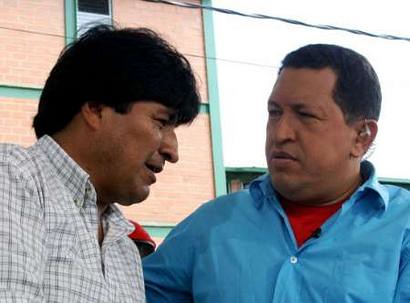
BBC reports that "Venezuelan President Hugo Chavez has arrived in [gas-rich] Bolivia and signed a number of far-reaching accords with his counterpart Evo Morales.
The deals include alliances between the state-owned oil companies and new joint mining and fertiliser ventures." It further notes that, "On Friday, Venezuela also signed a deal - delayed by pressure from the US - for eight military patrol boats from Spain. Washington says Mr Chavez is working to undermine US influence in the region." Gee, George, ya think?

BBC notes that Bolivian President Morales called the alliance an "axis of good". Chavez, Morales, and a Cuban representative believe that their system will benefit workers, peasants, and indigenous people.

As far as George Bush knows, South America does not exist. No one there, apparently, ever threatened to shoot his daddy.

Thursday, May 25, 2006

GUILTY!


Eron Trial Watch says the jury has reached a verdict that will be announced at noon, Eastern.

Do not ever, ever fuck with Grandma Millie. Or with any other grandmothers for that matter.

Wow. A Chick Talking About Energy. Must Be A Cold, Ballbusting Dyke In A Loveless Political Marriage.


Since the NYT and the kook kidz of the DC press corp are far more interested in how often the Clintons manage to have dinner together than they are in what Hillary has to say, I thought it only fair to reprint the text of her recent remarks on energy policy. Just in case anyone, you know, thought that might be as important as the precise lemon-yellow color of her pantsuit (or the fact that the scarf she's wearing is a Hermes plisse).

***************************************

It is wonderful to be back here at the Press Club. And I thank you for the invitation.

I am delighted to have a chance to talk about an issue that is not going away, and it is not just about gas prices, because we've been here before. We've seen gas prices go up and the country scurry around trying to decide what to do to wean ourselves from imported oil, to be more self-sufficient, only to have gas prices fall and everybody just forget about what we need to do to protect ourselves going forward.

So we've been hearing a lot about energy policy in the last several months, and I was thinking about my own very first encounter with the problems that we are coping with today.

About 35 years ago, I was in law school and I edited a paper for a fellow student who was writing about an obscure organization that I had never heard of, which would soon, he posited, be very important to the world's economy. It was called OPEC, or something like that.

And I have never forgotten that because, like most Americans, I had grown up with very cheap gas. My late father used to love gas wars. He would drive for miles. We'd get in the car, we'd spend hours looking for 20 cent gas. And sometimes you'd get to one corner and there'd be this gas war going on and, you know, the Sinclair station would be at 20 cents and then all of a sudden the Esso station would be at 19 cents. My father lived for that.

So from my perspective, energy had never been a problem, other than being told to turn off the lights when you left a room and turning down the thermostat at night.

I was like most Americans: not really tuned in to what it could mean if we let our energy future basically be determined by interests and forces outside of our own country and our own authority.

So while the security and the environmental challenges of our reliance on high-priced, mostly imported oil are very real, it is the economic challenge that is most visible to every American: those higher gas prices, rising inflation and now higher interest rates.

So Americans today are once again feeling the effects of runaway oil prices and the failure of our energy policies.

Now, there are no easy answers to the complexity of this problem, but I believe that we can get our arms around it. It will take a well-funded, comprehensive approach with staying power. Government has to change basically our do-nothing policies. Businesses have to be part of the solution, not the problem, and provide accessibility, efficiency and innovation. And we as citizens have to do much more to reduce our dependence on oil and begin to conserve and demonstrate more energy efficiency.

We can't just point fingers and, sort of, place blame on anyone else: foreigners over there, oil companies over here. The ball is in our court. It is up to us to act and to act soon. It is going to require a virtual revolution in our thinking about energy and in the actions that must follow.

Now, energy is at the heart of the three great challenges we face as a nation: How do we keep our economy strong in a more competitive world? How do we keep our communities safe in a more dangerous world? And how do we protect our values in a rapidly changing world?

Our present system of energy is weakening our national security, hurting our pocketbooks, violating our common values and threatening our children's future.

Right now, instead of national security dictating our energy policy, our failed energy policy dictates our national security.

We would never leave 10 percent of our military or intelligence assets vulnerable to an easy attack. But that's what we've allowed to happen with oil.

Just one terminal in Saudi Arabia handles about one out of every 12 barrels of the world's oil exports. That's enough to trigger a new crisis beyond the scale of the 1970s if it were cut off. Onem terrorist attack has already been foiled there, and other threats have been made.

We would never deliberately put ourselves in a position that allowed Iran to believe that because of its oil reserves it is invulnerable to sanctions for its dangerous nuclear program, or for Sudan to think that China will protect it from the consequences of genocide in Darfur in return for access to oil, or for Russia to use its energy policy to pressure its smaller neighbors.

But as world demand for oil pushes prices higher and intensifies the competition for future supplies, those are just some of the consequences of our present energy policy.

Energy we all know is essential to our economic security, and the trend lines are terrible.

Petroleum imports accounted for nearly one-third of our trade deficit last year. Now, that does hurt everyone. It does have economic consequences in the short, medium and long term.

Some industries face immediate threats. Every penny increase in gas prices costs U.S. airlines $180 million. Now, imagine what will happen if, as predicted, costs continue to double every five years.

High energy costs burden business and diminish our competitiveness, and they're also a strain on families. When energy prices are rising faster than incomes, every family feels the consequences, but our most vulnerable families feel them the worst.

Almost one in three low-income families have skipped medical or dental care, and almost one in four have missed a rent or mortgage payment because of energy expenses.

And finally, our values demand that we be good stewards of the planet for our children and our children's children. We are failing that simple moral test if we continue to stand by as the Earth warms faster than at any time in the past 200,000 years.

I have seen firsthand and have heard from the natives in places from Point Barrow, Alaska, to Svalbard, Norway, about the consequences of global warming. And now thanks to former Vice President Al Gore, who has been a committed visionary on global warming for more than two decades, everyone can see those consequences for themselves at a local movie theater.

But this is not a time, I would argue, for hand-wringing or despair, despite the formidable challenges we confront. We can fix these problems together by changing to a clean energy future fueled by innovation and efficiency.

And, of course, the alternative is pretty stark: If we don't change, our problems will only worsen.

The Department of Energy forecasts that demand for oil worldwide will rise more than 30 percent by 2025. Carbon dioxide emissions from energy use will rise almost 30 percent over the same period.

So our economy and our environment cannot afford the status quo.

And we can start not just looking at the problems, debating the problems, but understanding what prevents us from dealing with them. And I think that there are two myths that still block us from action and that boil down to the idea that we as individuals, as communities, as businesses, even as our country, are basically powerless.

You know, that kind of fatalism is just wrong. I would also argue that it is un-American.

First, too many people are still stuck on the idea that we will struggle for a very long time, hurt our economy and lose jobs if we try to change the way we fuel transportation and provide electricity to our economy.

But if we look at the evidence, that myth just does not hold up. In fact, the present crisis offers us a great opportunity to improve the lives of all Americans with more predictable energy prices, in a cleaner environment, with technology-driven job growth and new economic dynamism.

And the sooner we start, the sooner the benefits will kick in.

Denmark now gets 20 percent of its power from wind. Brazil makes enough ethanol to power 40 percent of its cars. Britain's switch to clean energy technologies has created hundreds of thousands of jobs in the last five years, while GDP has risen and the U.K. has hit its Kyoto targets to reduce greenhouse gases ahead of schedule.

We're now spending far more on military security in the Persian Gulf than it would cost to jumpstart a clean energy future with all the benefits in new jobs, enhanced security and reduced global climate change.

Here at home, energy guru Amery Lovins estimates that taking steps to eliminate our oil dependence will actually save the U.S. economy tens of billions of unproductive dollars per year by 2025. And that doesn't even count the benefits for our security and the environment.

Now, this can't happen overnight. And it does require a major change in policy and attitudes, not just in the government but also in the private sector and, indeed, in each of our lives.

But we need to resist the idea that kicking the oil habit will wreck our economy. In fact, the greater risk is that we will wreck our economy by failing to kick the habit.

Second, we need to discard the myth that conservation can't play a large role in our transformation. The easiest way to reduce our dependence on oil immediately is to use less.

Now, for some, it's become almost fashionable to make fun of conservation. A few years ago Vice President Cheney famously mocked conservation as nothing but a, quote, "sign of personal virtue irrelevant to our national energy needs." Now, the truth is that conservation is not just a personal virtue, but an important part of any sensible energy policy.

We worked our way out of the last big energy crisis in the '70s and early '80s almost entirely through conservation. From 1977 to 1985, our economy grew by 3 percent a year while oil use dropped 2 percent each year, driven by the increasing efficiency of our vehicles, our appliances, our businesses.

Think about this: If we got back on that pace today, it would take less than three years to reduce oil consumption by an amount equal to what we import from the Persian Gulf.

The opportunities are overwhelming. About 80 percent of the energy potential of oil is wasted in internal combustion engines. More than half the energy potential of coal is wasted in traditional utility plants. Almost all of our homes and commercial buildings could use energy more efficiently.

American business knows something the vice president needs to find out: Conservation is about efficiency, about doing more with less, not doing less with less.

Companies like General Electric and Dow Chemical have made major efforts to improve energy efficiency, and they've seen major improvements in their bottom line.

Six months ago, I outlined a set of proposals in a speech to an enthusiastic group of clean energy venture capitalists. It's called the Cleantech Venture Network. They're actually investing money in this new energy future, and they're being joined every day by more and more smart investors.

Today, I want to suggest a concrete goal of reducing our dependence on foreign oil by at least 50 percent by 2025. That would be a reduction in oil consumption of just under 8 million barrels a day.

Now, I believe a 50 by '25 initiative will energize our economy, not undermine it.

And how will we get there? Two words: innovation and efficiency. They encompass the three major tasks that I want to discuss today.

First, we need to convert our liquid fuel base from oil to biomass. That can reduce our consumption by 4 million barrels a day by 2025.

Second, we need to change our reliance on high-carbon electricity sources to low-carbon electricity sources through innovations in renewables such as solar and wind, as well as carbon dioxide sequestration.

The third task is efficiency: getting much more from the cars, buildings, power plants, manufacturing processes we have. Just by major efficiencies in cars, expanding hybrids, getting more fuel- efficiency from trucks, industrial and residential sources, we can reduce consumption by another 4 million barrels a day.

Now, efficiency will start us down the road to a better energy future, but an independent, clean energy future will require dramatic innovations. The possibilities are greater than ever for government, science and industry to succeed.

For example, scientists estimate that the wind potential of just three states -- Texas, Kansas and North Dakota -- is equal to more than half of the electricity we consume today. California could meet half of its power needs from solar alone.

Technology is finally bringing down the prices and making these innovations closer to commercial application every day.

Wind is the fastest-growing power source in our country and worldwide. It's now competitive with coal in areas where the conditions are right.

Both solar and wind costs drop by one-third every time capacity doubles, and that's now happening about every two years.

Last year, power generated from solar cells increased by 57 percent. And many states are making big bets on alternative energy, from solar arrays in Arizona to wind farms in Maine.

In upstate New York, there is a new wind farm that's gone in on acreage that has until now been primarily devoted to dairy farmers.

And it's got enough wind power to provide electricity to 50,000 homes. And it also, by the payments that it makes to the farmers, guarantees the farmers can stay on their land.

But we can't just wait for innovation. Just like the Manhattan or Apollo Projects, it takes focus and dedicated resources to make it happen.

That's why today I'll be introducing legislation for a strategic energy fund. We need a serious commitment from government to prioritize advanced energy and a commitment from our oil companies to reinvest their unanticipated profits into our shared energy future.

I want the oil companies to be part of the solution. Last year the top six oil companies had combined profits of $113 billion; more than the annual income of 170 countries.

Now, ExxonMobil had, you know, the highest profits in corporate history. Yet when CEO Lee Raymond was asked about how much his company had invested in alternative energy over the last decade, his reply was, and I quote, "a negligible amount."

Well, that's unexcusable. You know, the oil industry is making $300 million a day, not because they planned on it, not because of great managerial expertise, but because of escalating world demand and therefore increasing prices for this commodity that they didn't create in the first place.

I think it's time that we made sure they put a fair share of their profits toward a sound energy future.

Last month I joined with colleagues in writing the president to ask him to support Senator Cantwell's legislation to make price-gouging a federal crime in our oil and gasoline markets. Now, we still haven't heard back. But I want to reiterate that call today.

But we can do better than that. And here's how.

We need to reform our energy taxes so that large oil companies who reap huge benefits from unexpectedly high energy prices over the next two years will be required to pay a portion of their profits into the strategic energy fund.

Basically, if you take an average of their profits from 2000 to 2004, you add a 10 percent figure on top of that, then you can get to a point where those profits for just two years would be invested in the strategic energy fund.

Now, the oil companies would have the option: They wouldn't have to invest if they did this themselves, if they began making investments in biofuels, in other forms of renewable energy, in new, cleaner refining capacity, solar, wind. If they did it themselves, then they wouldn't have to pay into the fund.

And we ought to repeal the tax breaks that even the oil companies have told us they don't need and put that money into the fund as well.

With prices, profits and with these tax breaks in the fund, you could raise about $50 billion: more than enough to begin the energy revolution that we need.

Now, some of that money should go to reforming our tax code into an incentive not a disincentive to invest in clean fuels and diversify our energy sources.

Right now, our tax policies are totally upside down. We give large tax breaks for oil exploration far from our shores and limited tax breaks for installing biofuel pumps at America's gas stations.

We give consumers better tax breaks for buying Humvees than for purchasing hybrids and using clean energy.

So I support comprehensive legislation that would overhaul our energy taxes; signal the market we're in this for the long run by extending for 10 years the production tax credit; spur demand by doubling consumer tax breaks for hybrids, clean diesel and other advanced vehicles; and create a new tax incentive for fleet owners to purchase more efficient vehicles; speed the development of cellulosic ethanol by providing loan guarantees for the first billion gallons of commercial production capacity; ramp up the availability of ethanol by providing gas station owners with a 50 percent tax credit for the cost of installing ethanol pumps; and then extend and increase tax incentives for homeowners and businesses who will make their homes and businesses more energy-efficient -- there's a lot of good information out there abut how to do it, but unfortunately not much incentive to do it.

The strategic energy fund would allow government and business to work together to help solve some of the toughest scientific challenges that we have to deal with when it comes to energy and climate.

You know, we have the National Institutes of Health that promote partnerships for innovation. We ought to have something like a national institute of energy.

That's why last September I proposed a research agency modeled on the DARPA, the Defense Advanced Research Project Agency. And I was delighted that later that fall the National Academy of Science report endorsed the concept.

Now, DARPA was created what Sputnik went up. And the entire country just reacted as one -- "How could this happen?" It was a very unwelcome surprise.

Well, it was created with the idea we would bring our best minds together -- our universities, our business research labs, as well as government -- to try to figure out how to jumpstart and get ahead of the Soviet Union when it came to space technology.

Well, this succeeded, with stealth technology and global positioning satellites that empower our military, as well as a few surprises that today we all live with, namely the Internet and even the computer mouse.

Now, we'll never find the equivalent of stealth technology for energy if we don't look for it. Since 1978, federal and private spending on energy-related research and development has fallen more than 60 percent.

I propose that over the next five years we devote from the strategic energy fund $9 billion into this advanced research project agency for energy; we encourage creative, competitive projects; we think outside the box; we tell young inventors who maybe nobody's ever heard of before that there will be prizes for inventions that can help us move more quickly on the path to energy independence.

We also need to put the enormous purchasing power of the federal government to work, to help create markets for renewable electricity, more efficient vehicles and appliances, and biofuels. Federal buildings should be designed whenever possible and then retrofitted as well to meet the highest green building standards.

By 2010, we should require that the federal government purchase the most efficient cars made. That would create an annual market of more than 60,000 vehicles to spur continual improvements in technology.

By 2013, we should require that 10 percent of federal electricity purchases come only from renewable sources.

And by 2020 we should reduce federal oil consumption by 40 percent.

I'm very proud that in New York the Binghamton federal building was the first in the country to purchase 100 percent of its electricity from renewals.

Now, we can do all of this, and there are so many exciting developments. You know, if I'd here five years ago or 10 years ago, I couldn't have stood up here and said that we can do this, because we hadn't made some of the breakthroughs and it would have been a much more difficult path.

Yes, we could have done it, but it would have been much harder than what I believe is possible now.

You know, wind and solar power are terrific examples. Right now there's a two- to three-month backlog of orders for solar cells like the kind that are in the Clinton Library in Little Rock.

And wind is the fastest-growing source of energy. And one of the largest solar power systems in the country is at the Marine base in Twentynine Palms California, generating 10 percent of the base's needs.

We need a renewable portfolio standard to require 20 percent of electricity produced from wind, solar and other renewables by 2020.

Now, there is so much money to be made from this. And a couple of visionary companies have really gotten out ahead.

I want to applaud G.E. for its extraordinary commitment to a new energy future. G.E. will sell, this year, $3.5 billion worth of wind turbines and expects sales to reach $5 billion next year.

That supports jobs in four states, including my own. Investing in renewable energy creates more jobs than other energy investments; 40 percent more than a comparable investment in coal, for example.

Now, companies from Europe and Japan are flooding into energy markets that were pioneered by Americans. I don't want to lose either that technological edge or the jobs and exports that come from that kind of commitment.

Now, we can also make a gallon of gas go a lot further. You all have been reading and hearing a lot about the use of home-grown energy, clean diesel and ethanol made from corn, sugarcane, cellulosic materials.

We have an underused resource, American farmland, and rural communities across our country eager to try something new and do their part to help solve our energy problems.

Today we have 97 biorefineries located in 19 different states with the capacity to make nearly 4.5 billion gallons of ethanol.

Now, over the next 12 to 18 months, we will increase that capacity by 50 percent. And we're seeing it in New York as we're seeing it around the country.

But think about that: We have the capacity to make nearly 4.5 billion gallons of ethanol, but that is a long way from helping us deal with our gas problems. We need to be moving on a much faster track.

And last week, I met with the CEOs of the big three auto companies. They are enthusiastically ramping up production of flex-fuel vehicles. But there's hardly anywhere in the country to get your vehicle fueled if it's flex-fuel.

So we need to take immediate steps to make sure that the rapid expansion in biofuels continues and that we not only have the vehicles that can run on ethanol, but we have places where you can get them filled.

Right now there are more than 5 million flex-fuel vehicles on the road. Their owners may not even know it. Automakers could start with a good news recall to let owners know what's under their hoods and where to find a biofuel station.

We should put a $1 billion from the strategic energy fund into research aimed at unlocking the full potential of cellulosic ethanol. We can expand loan guarantees to help the first 1 billion gallons of cellulosic ethanol capacity come on-line.

And I think we've got to take action on this pump issue or we're just spinning our wheels, so to speak. I propose that we have ethanol pumps at 50 percent of gas stations nationwide by 2015 and 100 percent by 2025.

Obviously, these are goals. I hope we can go even faster.

We should start by requiring the big oil companies to install ethanol pumps at all the stations they own. We should also provide a tax incentive to the independents and other owners to do so over the next 10 years, and then a mandate to get it done immediately.

You know, biofuels is a tremendous opportunity for us, but we need to make sure we seize it. And the only way to do that is to have a supply and a demand chain that actually works for the average driver.

Now, as we talk about innovative clean fuels, I want to just mention clean diesel, because we don't use clean diesel as much in our country as they do in Europe, and I think it's another opportunity. Again, a home-grown opportunity.

Just two quick examples. At Corning, a wonderful company I represent in New York, they're making the filters to go on to school buses to clean up the pollution from old diesel. So they're dealing with the environmental impact of diesel.

At Cummins engine plant in Jamestown, they're building the engines that run on low-sulfur diesel. And we have to get the low-sulfur diesel rule fully implemented by 2007, which is the deadline.

The oil companies already got one delay, and we can't let that happen again, because companies like Cummins are investing billions of dollars in making sure that we have low-sulfur engines on the road. And if the oil companies won't step up to the plate on cleaner fuels, then they need to get out of the way and let innovative companies do that.

We also are making some progress in fuel cells, thanks to companies like Plug Power, General Motors, Delphi, Kodak. But we haveto deal with coal, because we have huge resources of coal. Coal is to us what oil is to Saudi Arabia. And part of our domestic strategy must involve coal.

But unless we learn to burn it cleanly, the price of independence from imported oil by using coal will be accelerated global warming. Even if the United States never burned another lump of coal, China is bringing on-line a 1,000 megawatt coal-fired power plant every 10 days. So if we're going to reassert our leadership on climate change -- which I think we should -- we've got to deal with coal.

And the first step is to take a mandatory cap-and-trade system, like that developed in the McCain Lieberman legislation that I support, but obviously going out and trying to reengage the rest of the world in this issue.

But unless we get to clean coal, it's going to be very hard to achieve.

Geologic sequestration, storing carbon deep within the earth after you extract the carbon from the burning coal, holds the key to making coal use compatible with the need to reduce greenhouse gas emissions.

Scientists believe we will be able to store nearly all of the carbon dioxide we currently emit for hundreds of years. But we need more real-world data, and that can only come from large-scale testing.

I propose we do two things to scale up the potential of clean coal.

First, undertake five large-scale tests of geologic sequestration in a variety of settings to really investigate the viability of this technology.

Second, provide tax credits for carbon sequestration to encourage domestic oil production. Oil companies already inject carbon dioxide into mature fields like the ones we have here in the United States to recover oil. The Department of Energy estimates that with oil priced at $40 or higher per barrel, it is economical, with ample CO2 supply, to use CO2 to recover 47 billion barrels of oil from existing U.S. fields.

Think of what we could recover at today's prices, as we were cleaning the air at the same time.

Nuclear is now very much in the news as a potential power source because of its lack of contribution to global warming. If you look at nuclear energy, which currently provides 20 percent of our energy with virtually

no emission of greenhouse gases, we do have to take a serious look, but there remain very serious questions about nuclear power and our ability to manage it in a world with suicidal terrorists.

So I have real concerns, specifically about a plant in my state near where I live, Indian Point, which has had a number of problems, and more generally with the capacity and quality of the oversight provided by the Nuclear Regulatory Commission.

So we need to resolve problems with the NRC, as well as questions of cost, safety, proliferation and waste, before we go forward with nuclear power.

But we can do all of that on the research/demonstration side while we are getting more efficient at the same time. You know, we could look at all of the options for efficiency. And there are many that we are just basically ignoring.

You know, last year in Auburn, New York, Nucor Steel spent $14 million on a continuous reheat furnace, money it will earn back in just three years through efficiency savings and higher productivity.

Texas Instruments was going to build its next plant in another country. Through efficiency, it decided to stay and build in Texas.

So I just would make a plea that we do more to set the standards for energy efficiency and let businesses and homes and others know more about what each of us can do and provide some technical assistance and support.

That's especially important with low-income people because we haven't done anywhere near what we should on weatherization of homes, which again helps cut bills for the persons living in the home but also saves energy for the rest of us.

Let's now talk about transportation, which is the hardest issue of all.

First, we do need to do more on mass transit. We need to look at places in our country where mass transit makes sense and make the investment.

Some states are doing that.

Now, we are missing a tremendous opportunity to save money and save energy because we haven't done enough on mass transit.

But we have to look at how we make more efficiency in transportation. We have to change the engines and fuels in the cars that Americans drive.

Hybrids is an example of what we need to do. You know, most foreign oil is used in automobiles: about 70 percent. And the surest way to reduce oil consumption is through hybrid technology that increases fuel-efficiency by 30 percent to 40 percent.

Hybrid sales are doubling every year. Manufacturers like Ford are setting ambitious goals for new hybrid production. We have major new improvements in hybrid engines coming on line. There's a really great partnership between General Motors, DaimlerChrysler and BMW that'll build state-of-the-art hybrid engines less than 50 miles from here in Baltimore.

The next step is hybrid plug-ins, enabling drivers to use household electricity to recharge car batteries at night. I saw some of these. They were on display on Capitol Hill. You can drive 100 miles or more for every gallon of fuel you put in the tank.

I also recommend what's called a fee-bate. That means for the least efficient old cars we need to provide a tax incentive so that people trade them in for more efficient cars.

And, finally, I do believe it's vital we make progress on fuel- efficiency standards. We can't separate, however, the challenge of making auto manufacturing more energy-efficient and the challenge of making U.S. manufacturing more competitive.

I believe we could do both. We need to be sure that our high standards don't provide an easy excuse for more auto jobs to leave the U.S., but I don't think that's the reason not to do it. We just need to be more creative about it.

We've been in a stalemate on CAFE standards for quite some time. I've worked with Senator Obama on legislation to offer auto companies assistance with retiree health care costs in exchange for them investing more in fuel-efficient cars.

That's a start. But we need the carmakers, the unions and the Bush administration to hammer this out. This is one of those moments that cries out for presidential leadership.

And President Bush will be meeting with the CEOs of the big three auto makers on June 2nd. And I think we should challenge all sides to take that opportunity to come back to Congress with a real proposal that will reform and raise our car fuel-efficiency standards and provide Detroit with the help it needs to ensure that the cars are designed and built here in the United States.

I also fully endorse an idea that Senator Lugar has been promoting.

We need a new commitment to a Strategic Petroleum Reserve. Specifically, we should increase it to hold 90 days of supply. We should use mandates and incentives to ensure that distributors hold similar stocks of gasoline, heating oil, jet fuel and other refined products. We should update the process of releasing oil from the reserve to make it transparent and responsive to short- term

market swings. And beyond that, we do need to work with other countries to build up strategic reserves in places like China and India that also can be buffeted by the global economy if they are not prepared, and that can then set off panic in the global marketplace.

This should be the first step of a major effort, as Senator Lugar has proposed, to develop strategic partnerships with those countries to work cooperatively on clean coal, climate change and other energy issues we cannot solve in isolation.

So here we are. There's a lot to be done, and I know that this is probably a more wonkish speech than many of you anticipated. But I feel so strongly about this because I'm afraid what has happened before will happen again.

Gas prices go up, everybody's in a panic, everybody talks about what we have to do. Gas prices go down. The sense of urgency recedes, and we just keep, sort of, stumbling forward into an energy future that we are not in control of.

Oil sits at $70 a barrel. Goldman Sachs predicts $100 a barrel by 2010.

So we have two choices here. We have two paths we can pursue.

You know, we can just let people stew in it and they can't afford to get to work; that's their problem.

I ran into a woman the other day who said, "You know, Senator Clinton, I don't know what I'm going to do. You know, my commute, 25 miles each way, is now costing me about $100 more. I don't know where that money's going to come from."

We can wait for the terrible potential of a terrorist attack to hit a pipeline, to hit a terminal, with all that that will mean to the world economy.

We can see global warming slowly but surely have the incredible effects it's having, from flooding and storms to desertification.

Or we can make a choice. And this is where I come down.

You know, I remember sitting in my office about a year and a half ago. And we were debating the McCain-Lieberman bill on the floor, which I have continually supported.

And one of my colleagues came to the floor in opposition. And he just basically said, "We can't do this. It'll ruin our economy. We'll go backwards. It'll destroy the American standard of living."

And I just couldn't believe what I was hearing. And I got up and I went to the floor and I said, "Since when have Americans become so fatalistic that we go around saying 'We can't do it, we can't do it'?"

That is not the tradition of our country. We can do it. We just need a commitment to do it. And we need the leadership in both the public and the private sectors to get it done.

And I believe that we definitely can get it done. So from my position today, I hope we make the right choice.

Thank you all very much.

Wednesday, May 24, 2006

Energy Harvesting


One excellent side effect of the publicity that Al Gore is receiving for AIT is the renewed (you should pardon the expression) interest in all kinds of non-polluting, or green, energy. BBC has a fascinating article on one of the most interesting forms of green energy -- energy harvesting. As BBC explains, energy harvesting looks "at ways to tap into the energy available from the workings of the human body or transport vibrations." The article notes that the "concept was pioneered by the military sector, largely bankrolled by the DARPA in the United States (Defense Advanced Research Projects Agency).

Their interest is mainly in reducing the need for soldiers to carry heavy rechargeable batteries that serve essential yet power-hungry communication devices. So they've looked at how 'heel-strike' generators, powered through the pumping motion of a footstep, can be embedded within a boot heel. These devices currently achieve upwards of 3 - 6 watts of power output."

The vibrations created when cars drive through tunnels could be used to power the lights in the tunnels. The vibrations created when hundreds of consumers walk from the subway to the street could generate the power used to heat the subway station. Eventually, energy harvesting could become a regular feature of all kinds of architecture.

There may not be one grand "answer" to our need for clean energy. There may be thousands of small answers that comprise both conservation and green energy. Energy harvesting is a great idea. Hopefully, the focus on AIT will lead to more funding for similar good ideas.

This is a Coup


Prior Aelred sent me this article from Project for the Old American Century, that does an excellent job of explaining a point I've been trying to make in several recent posts: "'A coup d'etat ... or just coup ... for short, is the sudden overthrow of (taking over from) a government. Unlike a revolution, which usually takes large numbers of people to take over, a coup can be done by a small number of people, or even one person, if they, for example, control the country's army,' Wikipedia

Generally, a coup is seen as the overthrow of those in power by another - usually with support of at least part of the military. Often this is imagined as a swift move followed by a consolidation operation (kill or expel those who were previously in power). However, a coup seems to be occurring in the United States, but it is a slow coup. It may be culminated by one drastic move that consolidates the plan, but the pieces are being clearly put in place for a coup of the entire government with the eradication of democracy and the Constitution."

Discussing "executive power," (including Bush's attempt to use "signing statements" to implement his "unitary executive" (aka dictator) theories), "intelligence," (including Bush's illegal spying on American citizens), and Bush's military reach into domestic affairs, Rowan Wolf (great witch name!) concludes that "we have an administration attempting to institutionalize their vision of a 'unitary executive.' It is also an administration which has directly supported eroding the Constitutional protections of the people as well as fighting any oversight or transparency. It is an administration which has supported, and dramatically increased the role of the military in domestic operations, intelligence and direct intelligence gathering (spying on people in person), technology transfer, and enforcement tasks. This raises the prospect of a coup, [yet]few seem to see this as anything more threatening than a 'temporary' situation."

There's a power in naming something by its true name. The true name for the Bush administration is a coup.

As I Said


From today's EEI newsletter:

"Wall Street Investors Climbing on the Climate Change Bandwagon
Investors, and not just socially-conscious ones, have begun targeting companies that control GHGs, believing climate change regulation in the United States is not far off, the New York Times reported today.

Wrote the Times: "New carbon-tilted rating scales could come in handy, and investment research houses like Sanford C. Bernstein and Innovest Strategic Value Advisers are busily setting them up. Innovest, in partnership with UBS, has created a carbon beta basket, a fund that will hold 50 stocks in five industries. The fund managers would monitor global warming regulations and would buy and sell the stocks on the basis of how the companies would be affected by those rules."

Investors develop lists of "carbon leaders" and "carbon dogs" to rank companies in the area of climate change control, according to Innovest. The investors also are betting on an emissions trading system being instituted. Wrote the Times: "Such a system plays to the basic math of the carbon beta basket. The companies selling the credits would receive an added source of income and therefore would be deemed ‘carbon leaders;’ the companies buying them will incur a new cost and will be deemed ‘carbon dogs.’ Even companies that decide to reduce their emissions could wind up as dogs, from the view of the carbon basket's fund manager, because they must incur costs to switch fuels or buy pollution control equipment."
New York Times , May 24."

Tuesday, May 23, 2006

Voters for Peace -- Take the Pledge Now


Go here and pledge to vote for peace.

Darfur: Finally Some Encouraging News


BBC reports some encouraging news concerning the genocide in Darfur. BBC explains that, "UN envoy Lakhdar Brahimi [described as "Mr Annan's top trouble-shooter"] is to try to persuade the government to accept UN peacekeepers in Darfur. A report by UN Secretary-General Kofi Annan accuses the Sudanese government of depriving Darfur residents of fuel and food, breaking humanitarian law." In particular, Brahimi will work to convince Sudanese leaders to accept a UN peacekeeping force, which would "take control of the peacekeeping mission from the 7.000 poorly equipped and under-funded African Union (AU) troops."

The women of Darfur need serious protection. Let's hope they get it soon.

AIT

Sending out an SOS to the world, sending out an SOS to the world. Bonus points if you get the reference w/o googling.

Monday, May 22, 2006

Higher and Higher Degrees of Organization, Flow, and Deep Silence


This, via Thorn Coyle, is good:

"Kilgore Trout once wrote a short story which was a dialogue between two pieces of yeast. They were discussing the possible purposes of life as they ate sugar and suffocated in their own excrement. Because of their limited intelligence, they never came close to guessing that they were making champagne." Kurt Vonnegut


"All outward forms of religion are almost useless, and are the causes of endless strife…..Believe there is a great power silently working all things for good, behave yourself, and never mind the rest." Beatrix Potter


Now go read the rest.

I'm not sure whether or not there's some cosmic force aiming towards "the good." Carol Christ kind of has me convinced no, Chardin kind of has me convinced yes. My garden kind of has me convinced no; my grandson kind of has me convinced yes.

But, in the end, I don't care. Aided by the universe, or headed into the wind, I need to be on the side of the Earth, on the side of women, on the side of the poor, on the side of art, on the side of thriving. I have to take responsibility for trying to figure out what "the good" is and for doing it. Back in the misty days of my discovering Wicca, I read somewhere that, "A witch takes responsibility." It sealed the bargain; I knew that I was home.

Al Gore Rocks


Go watch the trailer for An Inconvenient Truth

Gore: "This is not really so much a political issue as a moral issue."

Truer words were ne'er spoken.

Snakes


Swamped today, but here's another poem from Stanley Kunitz, who died last week at 100. It's about snakes, so after you finish it, go read Echidne, who's one of the best writers on feminism that I know.


THE SNAKES OF SEPTEMBER

All summer I heard them
rustling in the shrubbery,
outracing me from tier
to tier in my garden,
a whisper among the viburnums,
a signal flashed from the hedgerow,
a shadow pulsing
in the barberry thicket.
Now that the nights are chill
and the annuals spent,
I should have thought them gone,
in a torpor of blood
slipped to the nether world
before the sickle frost.
Not so. In the deceptive balm
of noon, as if defiant of the curse
that spoiled another garden,
these two appear on show
through a narrow slit
in the dense green brocade
of a north-country spruce,
dangling head-down, entwined
in a brazen love-knot.
I put out my hand and stroke
the fine, dry grit of their skins.
After all,
we are partners in this land,
co-signers of a covenant.
At my touch the wild
braid of creation
trembles.

Sunday, May 21, 2006

News Flash: High Tide Followed by Low


There's a small cafeteria in my office building and every day, every single day, they are not quite ready for the lunch crowd. You want to yell at them, "WTF? How can it continue to be a surprise to you that people suddenly start showing up here around noon EVERY SINGLE FUCKING DAY? Maybe tomorrow you could, you know, just assume that around 11:50 the cashier might want to get her change counted and be, oh, I don't know, AT THE CASH REGISTER?"

I work with a brilliant woman who normally comes into the office around 10:30 ish or works all day from home. Once in a while though, we have to be at court at 9:00 am or at the airport at 7:30. On those days, INEVITABLY, she calls me on my cell, running late, and says, in a surprised voice, "Traffic is really bad this morning!" And it's all I can do not to yell, "Yeah, Gail. Guess what? We work in Washington, D.C., one of the most congested cities in the entire United States. The traffic is bad EVERY morning. It was bad two weeks ago when you called me to say you were going to be late for court because of the traffic. It was bad a month ago when you called me to say you'd meet me at the other law firm for the deposition because traffic was bad. In fact, the next time that you've got to be somewhere early in the morning, maybe it would be smart for you to just ASSUME that traffic's going to be bad and leave in time to get where you're supposed to be!"

And, now we're coming up on another election. Five months, give or take. Electoral politics are going to be heating up, as they do EVERY SINGLE TIME THERE'S AN ELECTION. And I'd really, really, really like to think that THIS time, the Democrats won't act like the cashier in my cafeteria or my co-worker, caught totally off-guard by what anyone else could see coming a mile away. Here are a few things the Democrats need to get ready for NOW.

1. "You're saying you think it was better with Saddam in power."

2. "You're giving aid and comfort to the terrorists."

3. "You're for tax and spend."

4. "My opponent wants to cut and run."

5. "Most liberal, most liberal, most liberal."

6. "I respect my opponent's military service, but . . . ."

7. "You want gays to take over our country, convert our children, and burn our bibles."

8. "This time, trickle down economics will lift all boats."

9. "We'd have fifteen cent a gallon gas if my opponent weren't more concerned about the caribou than she is about working Americans and their gas bills."

10. 9/11, 9/11, 9/11, 9/11!

Look, I'm a witch and I have accesss to deep, esoteric secrets, vast, arcane wells of wisdom. And I'm going to share a few secrets with you:

Tomorrow, a strange yellow ball will rise in the eastern sky. Tomorrow, in the evening, the moon will be about three percent smaller than it will be tonight. And the Democrats, caught offguard again by the very tactics that Rove used an entire two years ago, won't have a good, standard, sound-bite-sized answer for any of the above-ten points. Come on, Dr. Dean, surprise me. Prove me wrong. Please.

Sunday Akhmatova Blogging


I've been reading around on the internet and trying to understand what was going on in Akhmatova's mind and heart that led her to write what she wrote. The web is an interesting way to learn about a new subject; there's a ton of information out there, but it's disjointed, disorganized, in disarray.

She followed her heart very willingly, did Akhmatova, marrying poets and Assyriologists and loving (and being loved by) many others.

Bopping around on the web, I came across several different translations of a poem of hers called Song of the Last Meeting. Comparing them helps me to understand what she may "really" have been saying, since I can't read her in the original Russian. Which do you prefer?


FIRST TRANSLATION:

Song of the Last Meeting (1911)

My breast grew helplessly cold,
But my steps were light.
I pulled the glove from my left hand
Mistakenly onto my right.
It seemed there were so many steps,
But I knew there were only three!
Amidst the maples an autumn whisper
Pleaded: "Die with me!
I'm led astray by evil
Fate, so black and so untrue."
I answered: "I, too, dear one!
I, too, will die with you..."
This is a song of the final meeting.
I glanced at the house's dark frame.
Only bedroom candles burning
With an indifferent yellow flame.

SECOND TRANSLATION

Song of the Last Meeting

My breast was chilled through, oh so helpless,
But my steps were still very light.
I picked up the glove for the left hand
And put it by chance on the right.
It seemed like the steps were so many,
But I knew there were only three!
Fall's whisper, with maple-trees blending,
Requested: "Now die with me!

I'm deceived by this my specious
Fate far too fickle, untrue."
I replied: "My precious, my precious!
Me too. I shall die with you..."

'Tis the song of our very last meeting.
I glanced at the house now all dark.
Only candles in the bedroom were burning
With a nondescript yellowish spark.

English verse translation © John Woodsworth
Ottawa (Canada)
20 January 2002

THIRD TRANSLATION

Song of the Last Meeting
by Anna Akhmatova

I was help less and my breast was freezing
But I walked and my footsteps were light.
And the glove that was meant for my left hand
I unthinkingly put on my right.
And it seemed that there were so many steps then,
But I knew there were only three!
In the maple trees there where the whisper
Of autumn that said, 'Die with me.

For I've been deceived by a whimsy
Called Fate-sad, wicked, untrue.'
I answered, 'I've been deceived also,
My dear, and I'll die with you.'

This: the song of our last meeting...
I looked back at the dark house's frame;
In the bedroom the candles were burning


HECATE'S ATTEMPT TO CHERRY-PICK THE BEST OF THE ABOVE THREE TRANSLATIONS:

The Song of Our Last Meeting

My breast was chilled through; I was helpless,
But my steps were still very light.
Unthinking, I pulled my left-hand glove
Mistakenly onto my right.
It seemed there were so many steps then,
But I knew that there were only three!
In the maple trees there was a whisper
Of Autumn that said, 'Die with me.

For I've been deceived by Fate's whimsy
And Fate's been sad, wicked, untrue.'
I answered, 'I've been deceived also,
My dear, and I'll die with you.'

This is the song of our very last meeting.
I glanced at the house, now all dark.
Except the bedroom candles were burning
With a nondescript yellowish spark.

*****************

In the end, I'm struck by what may have been only a sense-impression or a throw-away line for Akhmatova: "Except that the bedroom candles were burning with a nondescript yellowish spark." She's leaving him not only because the rest of the house was dark but because, in the end, the sex just wasn't that good. So, translating various translations may be a poor way to learn what a poet was saying, kind of like trying to understand a painting by painting a copy of a copy reflected in a mirror. But it helps me, I think, to access Anna.

Why do I care? What makes it worth the effort? I can't thrive -- hell, I don't think I could live -- without poetry. Thriving isn't something that happens to us; it's something we do. What must you have to thrive? How much time do you spend doing it? If not, why and if not now, when? If we allow ourselves to wind down, to quit thriving, then John Ashcroft and Dick Cheney have won.